

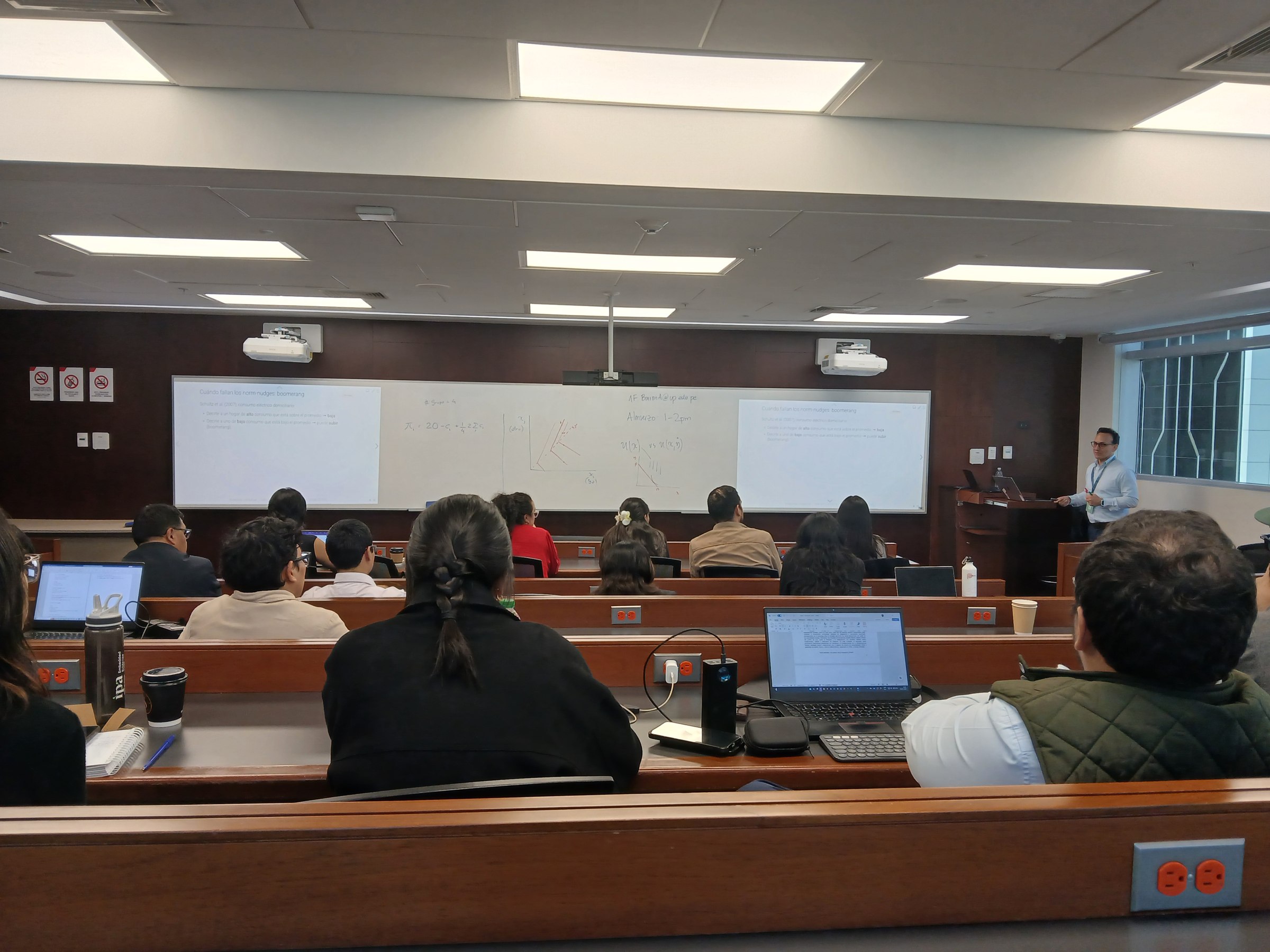
A day of training on the foundations of behavioral economics, its experimental evidence, and its implications for teaching and research.
Learning objectives
- Understand the main behavioral economics models and their relationship to the standard model of choice.
- Interpret laboratory and field evidence and formulate questions that can be studied through experiments.
- Assess implications for teaching, research and welfare.
Academic program
09:00–11:00
Foundations of behavioral economics
Bounded rationality, choice under risk, heuristics, prospect theory and loss aversion.
11:00–13:00
Intertemporal choice and self-control
Discounting, present bias, time inconsistency, commitment devices and limited attention.
14:00–16:00
Social preferences, identity and social norms
Altruism, reciprocity, fairness, identity and social image; evidence on cooperation and trust.
16:00–18:00
Beliefs, learning and welfare
Belief updating, overconfidence, motivated reasoning, internalities and behavioral welfare.
Syllabus and materials
Co-organizers
- Asociación Peruana de Economía (APE)
- Consorcio de Investigación Económica y Social (CIES)
- Facultad de Economía y Finanzas · Universidad del Pacífico
- LACEA BRAIN
← Training